Lucas Pereyra y Maiko: relación padre-hijo
La uruguayaLucas Pereyra’s relationship with his son Maiko is both a source of profound attachment and the pressure that most sharply exposes Lucas’s vulnerability. Lucas describes the exhaustion and fear of parenting without diminishing his love for Maiko; their bond shifts from an imagined, fused family body to a life shared across two homes, where care persists through routines, visits, and absence.
Love and the work of care
Lucas recalls Maiko’s early childhood through the practical demands that filled his days. A birthday approaches, and the memory of the previous year’s successful train-shaped cake—made from three long loaf tins, chocolate icing, sweets, and wafer rolls—makes him feel the pressure of planning another celebration. In a toy shop, he notices a person-sized dinosaur and wonders whether Maiko would identify it. Even these small errands carry the weight of a father’s attention: a present has to be chosen, a birthday remembered, a child’s interests considered.
That tenderness coexists with fatigue. Lucas remembers the constant supervision involved in caring for a very young child: Maiko could become upset, cry, resist walking, make a mess in a restaurant, and fall asleep wherever exhaustion overtook him. Lucas’s description does not make Maiko a problem to be solved; it registers how thoroughly a child reorganizes an adult’s time and attention. The work continues at home, in bathing and bedtime, and in the disruptions that make ordinary plans uncertain.
Lucas is explicit that he adores Maiko and loves him more than anyone in the world. What overwhelms him, he says, is often not Maiko himself but the steady worry that comes with being responsible for him. Fatherhood introduces fears Lucas had not known before: that something might happen to him, to Maiko, or to Catalina, leaving the child vulnerable. When Maiko runs ahead toward a street corner, Lucas has to call after him without knowing whether he will stop. The episode makes care less an abstract feeling than an ongoing vigilance, renewed in everyday moments.
Fear, dependence, and the family body
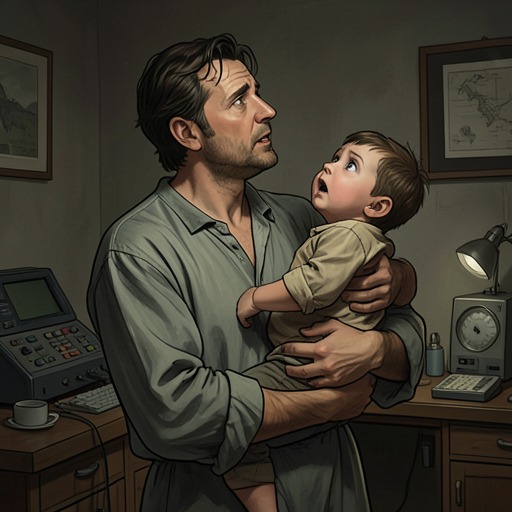
Lucas’s recollections move between comic frustrations and the moments that make parental fear unmistakable. He remembers the disruption of nursery illnesses and the demands of early childhood, but the sharpest memory is Maiko’s fever-related convulsions. Lucas thought his son might die in his arms; doctors later explained that such episodes are common and not serious. Their reassurance does not erase the shock of the experience. Instead, Lucas reflects on how little prospective parents can be taught about the frightening realities of care, and how a complete warning might deter people from having children at all.
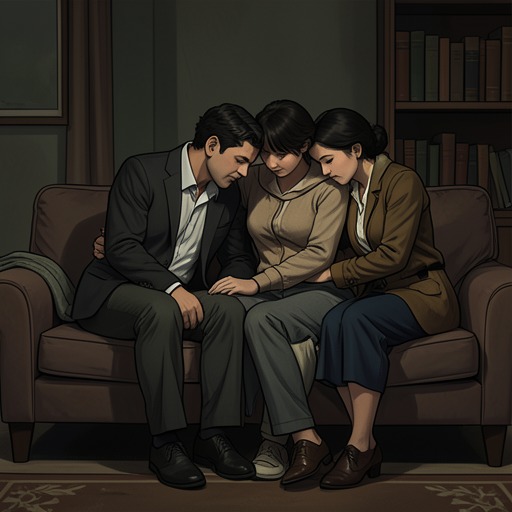
This vulnerability deepens an idea that also shapes Lucas’s account of adult intimacy: the family can seem like a single organism, with its members bound together by a shared circulation. He describes the child as completing and sealing the couple’s embrace, and the three-person family as a body in which separate boundaries blur. In that image, attachment offers closeness but also intensifies fear: harm to Maiko would not feel external to Lucas but would strike at the shared life he imagines them inhabiting. The metaphor expresses the force of his care, while also revealing how frightening it is to love someone whose safety he cannot guarantee.
The family-body image is not simply a celebration of unity. Lucas’s reflections on the couple’s lost privacy make clear that closeness can become suffocating when individual boundaries disappear. His account places Maiko within that tension, not as its cause but as part of the family form that Lucas and Catalina built. Parenthood expands the bond between them and makes their shared responsibilities more consequential, even as their adult relationship later changes.
Separation and a continuing bond
After Lucas and Catalina separate, Maiko’s life takes a regular pattern between the two parents: he spends part of the week with Lucas and part with Catalina. Lucas reports that Maiko adapts quickly, while wondering whether the child adapts too readily. A neighbor treats Maiko’s time with his father as a visit; Maiko makes clear that he lives with Lucas too. The distinction matters. Their relationship is not reduced to occasional contact after the separation: Lucas remains one of Maiko’s homes.
The new arrangement brings both reassurance and longing. Lucas says that he misses Maiko on the days they are apart. His account does not claim that the change is effortless, but it presents the shared schedule as a workable family arrangement, with Maiko able to name his place in both households. His fatherhood continues through the ordinary structure of the week rather than through the intact couple’s shared home.
A small instrument becomes attached to this changed domestic life. Lucas had bought a ukulele as a gift for Maiko. After Lucas is robbed in Montevideo, he considers smashing it in a moment of anger, but Magalí Guerra stops him. Maiko later brings the instrument to Lucas’s apartment during his first weekend visit there and leaves it behind. Lucas learns to play it, and says that it sustains him through a difficult period of living alone. The ukulele’s importance belongs first to Lucas’s recovery, but its path through the story also ties that recovery to his role as Maiko’s father: it begins as a gift for his son and becomes part of the household Maiko visits.
A changed family and an ongoing role
Lucas’s later reflections describe a simpler life after the separation. He has given up the car, and Maiko attends public school, where Lucas observes that he has adapted. These changes are presented as practical improvements rather than as proof that separation has removed every difficulty. The school routine and the divided week give the father-son relationship a stable setting in a reorganized family.
The contrast between Lucas’s early image of three people as one body and Maiko’s later life in two homes marks a change in how the family is lived. The account does not suggest that love has ended or that the new arrangement dissolves the bond. Instead, Lucas continues to organize his life around Maiko while acknowledging the ache of not seeing him every day. Maiko’s insistence that he lives with his father gives that continuing relationship its clearest expression: separation changes the household, but it does not make Lucas a visitor in his son’s life.